
MYOPIA CONTROL GLASSES COMPARED · SYDNEY
MiyoSmart vs Stellest vs MyoCare — which suits your child?
An evidence-based comparison from the optometrists who fit all three.
Reviewed by Dr Mark Joung, B.Optom (Hons) UNSW · Last updated May 2026
THE QUICK ANSWER
Three myopia control lenses, three different strengths.
Ranked by depth of published clinical evidence.
The short version
At a glance
How the three lenses compare.
The decisions that actually matter to parents.
| MiyoSmart (HOYA) | Stellest (Essilor) | MyoCare (Zeiss) | |
|---|---|---|---|
| Technology | D.I.M.S. — honeycomb of defocus segments | H.A.L.T. — 1,021 aspherical lenslets in rings | C.A.R.E. — concentric rings + freeform back surface |
| Available in Australia since | October 2020 (iQ from Aug 2026) | October 2022 | July 2023 |
| Longest peer-reviewed follow-up | 6 years (Lam et al., 2023) + 8-year interim | 5 years (Li et al., 2025) | 2 years (Chen et al., 2025) |
| Trial population | Chinese children + UK/European observational | Chinese + ethnically diverse US RCT | Parallel Asian + European trials |
| Regulatory status | Widely approved, including AU | First and only US FDA-authorised spectacle lens | Widely approved, including AU |
| Photochromic option in AU | Yes — MiyoSmart Chameleon | Not currently | Not currently |
| Lens material options | 1.59 polycarbonate | 1.59 polycarbonate | 1.5, 1.59, 1.6, 1.67 (thinnest for high Rx) |
| Newest generation | MiyoSmart iQ — fitting now (general AU launch Aug 2026) | Stellest 2.0 (rolling out 2026) | MyoCare S already available |
| At Concord Eyecare | Yes — now fitting MiyoSmart iQ (early access) | Yes — including Stellest 2.0 | Yes — through our Zeiss partnership |
Swipe sideways to see all three lenses →
Seen the options? The right one depends on your child.
That's exactly what we work out together — with measurements, not marketing.
Best option by profile
Different children, different first-line lenses.
How we'd typically match a lens to a child.
A starting point only — final decisions happen at the consultation, after we measure your child's prescription, axial length, and assess fit and lifestyle.
New to myopia control, standard prescription
MiyoSmart iQ or Stellest 2.0Fast progressor (more than 0.50 D per year or rapid axial growth)
MiyoSmart iQOn atropine drops or starting combination therapy
MiyoSmart ChameleonActive outdoor child or sensitive to glare
MiyoSmart ChameleonHigh prescription (–5.00 D and beyond)
MyoCare (1.67 high-index)Which myopia control lens is right for my child?
The comparison ends with a measurement, not a guess.
We measure the eye itself, not just the prescription
A glasses prescription measures refraction — and refraction fluctuates with focusing effort, especially in children. Axial length doesn't. We measure it here on the Zeiss IOLMaster 500 optical biometer: a brief flash of infrared light, about 30 seconds per eye — the scan itself needs no drops and never touches the eye. Axial length is what myopia control treatment sets out to slow. How axial length works →
The SightTrack chart: a child's eye growth, tracked against age
Children's Myopia Assessment
$95
Out of pocket · 45 minutes · one visit · the fee is the same whichever lens follows — or none does
Cycloplegic examination and axial length measurement — both included
Your child's eye growth plotted against age norms, explained on the spot
You leave knowing what we'd recommend for your child, and why — even if that's no lens at all
Assessed by an optometrist who fits all three lenses on this page

Dr Mark Joung, Principal Optometrist
Fits all three lenses on this page · 800+ Ortho-K fits · one of the first Australian optometrists to fit MiyoSmart
Children's Myopia Assessment — $95. Prefer to read more first? See what happens at the assessment
HOW EACH LENS WORKS
Three different ways to send the eye a slow-down signal.
The optical design behind each technology.
All three lenses correct your child's vision through the central zone — just like ordinary glasses. The myopia control happens around that central zone, where each brand uses a different optical design.
MiyoSmart: a honeycomb of defocus
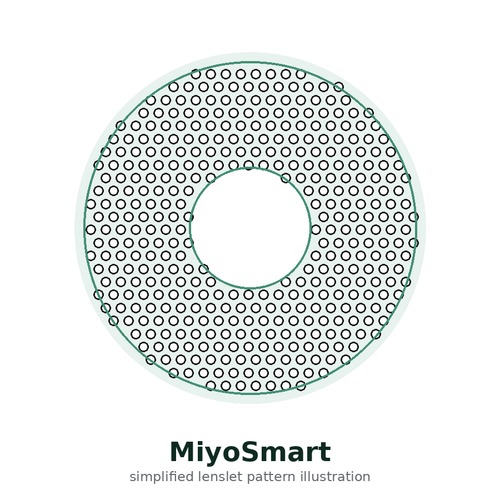
Around the 9.4 mm central clear zone, MiyoSmart places hundreds of tiny defocus segments in a honeycomb pattern. Each segment creates a controlled blur that signals the eye to slow its growth.
For your child: central vision as sharp as ordinary glasses; most children adapt within a week.
Stellest: a constellation of lenslets
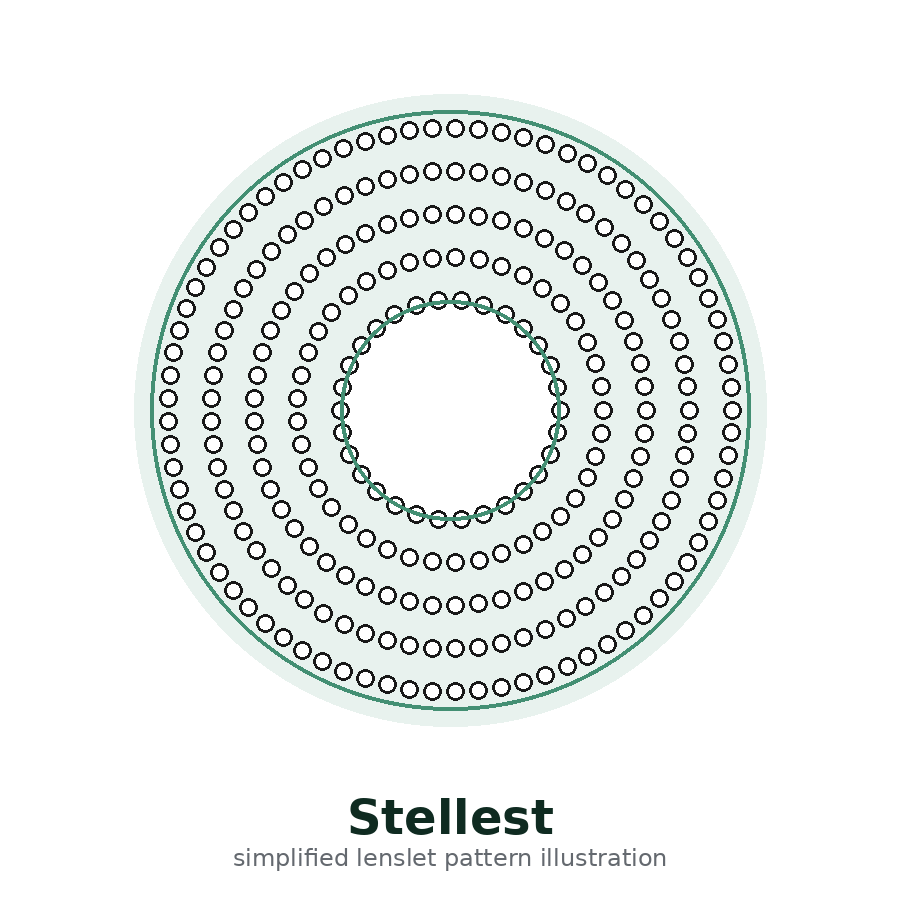
Stellest uses 1,021 aspherical lenslets arranged in 11 concentric rings around the central clear zone. Rather than creating a single focal point, they create a "volume" of out-of-focus light in front of the retina.
For your child: the lenslets are very subtle — most people don't notice them. Adaptation typically inside a week.
MyoCare: rings plus a smarter back surface
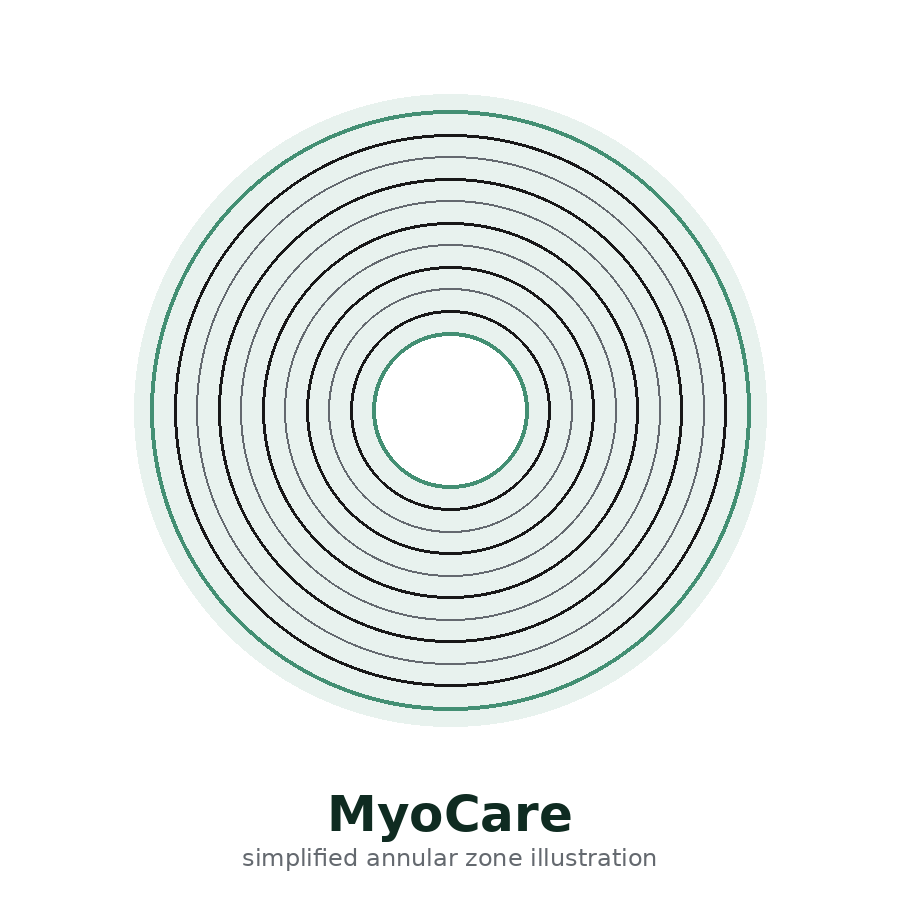
MyoCare uses concentric rings of microstructures rather than discrete lenslets — plus a freeform-optimised back surface, the only one of the three to adjust the back of the lens to reduce unwanted peripheral focus.
For your child: microstructures nearly invisible. Two variants — MyoCare for younger kids, MyoCare S for older.
WHAT THE RESEARCH SHOWS
Evidence depth, ranked.
Ranked by published clinical evidence, not by which works best for your child.
MiyoSmart (HOYA)
Deepest published evidence baseWhat the data say: MiyoSmart has the longest peer-reviewed follow-up of any myopia control spectacle lens. The 6-year study found the treatment effect sustained, with no rebound when children stopped. The original trial was in Chinese children; independent UK and European observational studies have since shown it works in mixed-ethnicity populations.
Honest limitation: the longest data are in Chinese children; European and UK data are observational rather than randomised.
Stellest (Essilor)
Strong evidence; only FDA-authorised spectacle lensWhat the data say: Stellest has 5 years of peer-reviewed follow-up from the original Chinese trial, plus a 2-year US trial in an ethnically diverse group of children (White, Asian and Black). In September 2025 it became the first and only spectacle lens authorised by the US FDA for slowing myopia progression in children.
Honest limitation: the 5-year follow-up uses an extrapolated comparison group rather than a maintained randomised control — a choice the researchers defend on ethical grounds, but worth knowing about.
MyoCare (Zeiss)
Newest of the three; intentional dual-ethnicity designWhat the data say: MyoCare was designed from the outset with parallel trials in Chinese and European children — a deliberate strength. The technology is genuinely innovative (the only lens of the three with an optimised freeform back surface) and the only lens available in Australia in 1.67 thin-index material, which matters for higher prescriptions.
Honest limitation: the published follow-up is the shortest of the three, and no data have been published yet on what happens if your child stops wearing the lens.
WHAT'S NEW IN 2026
Stellest 2.0 and MiyoSmart iQ.
The newest generation of myopia control lenses.
Both Essilor and HOYA have launched next-generation versions in 2025–2026. The newer designs use smaller central clear zones with stronger peripheral defocus — which means fitting precision matters more than ever.
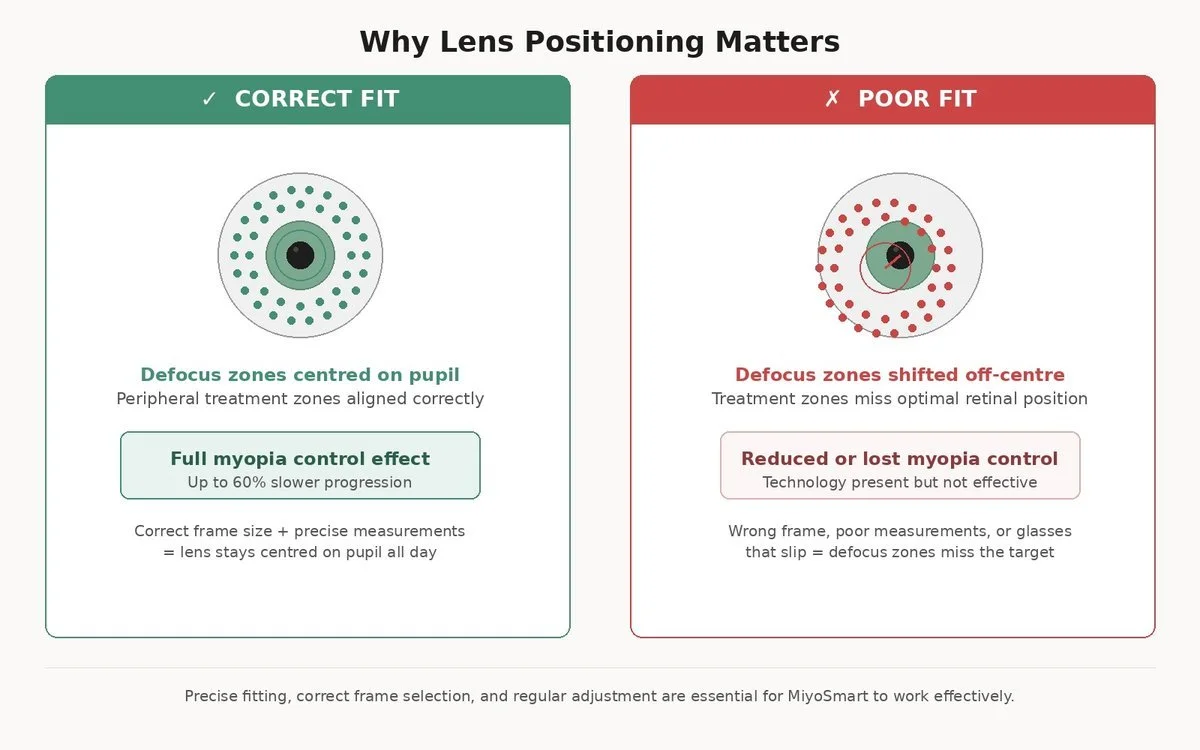
This principle applies to all myopia control lenses — the effect is amplified with next-generation designs that have smaller central zones.
HOYA has also added a new Smooth Touch Xtreme coating to MiyoSmart lenses — built to stay cleaner and clearer through years of children's wear (HOYA reports easy cleaning maintained after around 8,000 wipes). It doesn't change how the lens controls myopia; it's about everyday durability.
Stellest 2.0 (H.A.L.T. MAX)
The new generation uses 12 rings of lenslets instead of 11, with higher lenslet power and stronger asphericity in the periphery. In a 12-month Singapore study of 50 children, eye growth was 1.88 times slower with Stellest 2.0 than with the original Stellest.
Why fit precision matters even more: the smaller central clear zone means pupil distance and pupil height measurements need to be precise — a slightly off fit can shift the defocus pattern away from where it needs to sit, compromising your child's central viewing area.
Our take: encouraging early data, but the comparison was against the previous Stellest, not against ordinary glasses. Long-term data are still to come. Our current first-line recommendation for fast progressors.
MiyoSmart iQ (DIMS Triple Enhanced)
The iQ version shrinks the central clear zone, moves defocus segments closer to the centre, and increases defocus power. In HOYA's 12-month trial of 196 children (presented at ARVO 2026), children wearing MiyoSmart iQ showed no myopia progression on average over the first year — the strongest result reported so far for a DIMS-based lens.
Our take: impressive early results, but this is a single 12-month, manufacturer-funded study that hasn't yet been through peer review — so we read it with the same caution we'd apply to any new lens. We'll watch the published data as it matures.
We're one of a small number of Australian optometrists selected to fit MiyoSmart iQ ahead of its general release. If you'd like to consider the newest option for your child, we can talk it through at a myopia assessment.
Learn more about MiyoSmart iQ →
PHOTOCHROMIC OPTION
MiyoSmart Chameleon: one pair that does both jobs.
The only photochromic myopia control lens in Australia.
Of the three lenses we fit, only MiyoSmart has a photochromic version available in Australia — the lens darkens outdoors and clears indoors, so your child doesn't have to swap between clear glasses and sunglasses.
It uses the same DIMS technology underneath, with a photochromic film added. 100% UV protection even when the lens is clear. Fades back to clear within about a minute when your child comes back inside.
A practical pairing with atropine drops: if your child is on low-dose atropine for myopia control, the drops dilate the pupil slightly and cause light sensitivity. Chameleon photochromic lenses reduce that glare automatically — making combination therapy more comfortable day-to-day.
An iQ version of Chameleon is expected in Australia around August 2026. Until then, Chameleon remains the photochromic option — at the same $690 as our other lead lenses, with no photochromic surcharge.
For kids who spend a lot of time outdoors · Reduces glare for children on atropine drops · $690 — same price, no surcharge
TRANSPARENT PRICING
What you can expect to pay.
Lenses, monitoring and ongoing care — all priced up front.
- MiyoSmart iQ — $690 per pair (our newest-generation lead lens)
- Stellest 2.0 — $690 per pair
- MiyoSmart clear or Chameleon photochromic — $690 per pair (no surcharge for Chameleon)
- Full Control coating (UV + blue light) — add $50 to any MiyoSmart lens
- MyoCare — varies by index chosen (1.5, 1.59, 1.6 or 1.67 for higher prescriptions)
- Frames priced separately — children's frames from $150. Tomato Glasses, built to hold myopia-control lenses in the right position, are $210
- Axial length measurement — included in the Children’s Myopia Assessment. Once your child is in the program, six-monthly review scans are $45. We use a Zeiss IOLMaster biometer to track your child's actual eye growth
- Private health fund extras rebates apply — we claim on the spot via HICAPS
A full quote in writing before any lenses are ordered. No surprises at pick-up.
PROS AND CONS BY LENS
The case for and against each.
What we'd flag to parents face-to-face.
MiyoSmart (HOYA)
- Longest peer-reviewed follow-up (6 years)
- Chameleon photochromic pairs well with atropine — reduces the glare from pupil dilation
- Most peer-reviewed combination data with atropine drops
- No rebound effect documented after stopping
- Widely studied across populations
- Only 1.59 polycarbonate material — thicker for high Rx
- Foundational long-term data are in Chinese children
Stellest (Essilor)
- First and only US FDA-authorised spectacle lens
- Stellest 2.0 is a strong choice for fast progressors — a close alternative to MiyoSmart iQ
- Ethnically diverse pivotal US RCT (White, Asian, Black)
- Lenslets nearly invisible cosmetically
- 5-year peer-reviewed follow-up data
- 5-year data uses extrapolated control group
- Stellest 2.0 requires more precise fitting due to smaller central zone
- Only 1.59 polycarbonate material
- No photochromic option in Australia
MyoCare (Zeiss)
- Only myopia control lens available in 1.67 thin index — essential for –5.00 D and above
- Microstructures nearly invisible
- Parallel Asian + European trial design
- Only lens with optimised freeform back surface
- Shortest published follow-up of the three (2 years)
- No published rebound or washout data yet
- Typically our recommendation only when thinner lenses are clinically necessary — we discuss the research trade-off openly
- No photochromic option in Australia
Explore each option in depth
Leaning a direction, or want to read further before your child's assessment? Each page goes deeper than this comparison.
HOW WE DECIDE IN CLINIC
The right lens is a conversation, not a formula.
What we work through with you at the myopia assessment.
At your child's myopia assessment, we walk through these factors and recommend the lens that fits best — not the one with the glossiest marketing.
We measure axial length, not just your child's prescription
The most meaningful measure of myopia progression isn't the glasses prescription — it's the length of your child's eye. We use a Zeiss IOLMaster 500 biometer (the same gold-standard device used before cataract surgery) to measure axial length at baseline and at every six-month review. It tells us whether a lens is actually working for your child, not just whether their glasses still focus.
FREQUENTLY ASKED QUESTIONS
Questions parents ask most often.
What we get asked at the consultation.
Which lens slows myopia the most?
Head-to-head studies have found the three lenses closer to each other than any of them is to ordinary glasses. The brand matters less than wearing the lenses consistently and fitting them correctly. We recommend the best option for your child at the consultation.
Can my child use myopia control glasses with atropine drops?
Yes — combining myopia control glasses with low-dose atropine drops can add further benefit for faster progressors. Because atropine dilates the pupil slightly and causes light sensitivity, we often recommend MiyoSmart Chameleon photochromic lenses alongside the drops to reduce glare. Dr Mark Joung is therapeutically endorsed and can prescribe atropine directly, without needing a GP referral.
Will the lenses look weird or thick?
No. The myopia control technology sits outside the central viewing zone, so when your child looks ahead the vision is as clear as ordinary glasses. The lenslets and microstructures are very subtle — most people don't notice them. For higher prescriptions above –5.00 D, MyoCare is available in a thinner 1.67 index material.
How long will my child need to wear myopia control glasses?
Most children benefit through to their late teens, when eye growth typically stabilises. We track axial length at every six-month review so we can see when progression slows naturally.
What happens if we stop using the lenses?
The 6-year MiyoSmart data found no rebound — children who stopped did not progress faster than they would have without ever wearing the lenses. Data for Stellest and MyoCare after discontinuation is more limited, which is one of the things we discuss with you.
Can we switch brands if one isn't working?
Yes — we can move your child between lenses if the first choice isn't delivering the progression control we want to see. Because we fit all three, we're not locked into defending one brand if another suits your child better.
How much does myopia control cost?
Myopia control lenses start from $690 per pair — MiyoSmart iQ and Stellest 2.0 are both $690, and MiyoSmart Chameleon photochromic is also $690 (no surcharge). The Full Control coating upgrade (blue-light + UV) adds $50. MyoCare varies by index. Frames are separate — children's frames from $150, and Tomato Glasses, built to hold myopia-control lenses in the right position, are $210. Getting started is the Children’s Myopia Assessment — $95 out of pocket, with axial-length measurement included. Once your child is in the program, six-monthly review scans are $45. Private health fund optical extras rebates apply. We give you a full written quote before ordering.
How often will my child need new lenses?
We review your child every six months with an axial length measurement and refraction check. If the prescription changes by 0.50 dioptres or more within the warranty period, the lenses are replaced under the manufacturer warranty — terms vary by brand.
Find the right myopia control lens for your child
A 45-minute assessment, including axial length measurement, with an optometrist who fits every option on this page. No pressure.
REVIEWED BY
References
- Lam CSY, Tang WC, Tse DY, et al. Defocus Incorporated Multiple Segments (DIMS) spectacle lenses slow myopia progression: 2-year RCT. British Journal of Ophthalmology 2020;104(3):363–368.
- Lam CSY, Tang WC, Zhang HY, et al. Long-term myopia control effect and safety in children wearing DIMS spectacle lenses for 6 years. Scientific Reports 2023;13:5475.
- Bao J, Huang Y, Li X, et al. Spectacle lenses with aspherical lenslets for myopia control vs single-vision lenses: RCT. JAMA Ophthalmology 2022;140(5):472–478.
- Li X, Huang Y, Liu C, et al. Myopia control efficacy of HAL spectacle lenses: 5-year follow-up. Eye and Vision 2025;12(1):10.
- Alvarez-Peregrina C, et al. CEME study: clinical evaluation of MyoCare in Europe — 1-year results. Ophthalmic and Physiological Optics 2025;45(4):1025–1035.
- Chen X, Wu M, Yu C, et al. Efficacy of CARE spectacle lenses over 2 years. American Journal of Ophthalmology 2025.
- Brennan NA, Toubouti YM, Cheng X, Bullimore MA. Efficacy in myopia control. Progress in Retinal and Eye Research 2020;83:100923.
Concord Eyecare serves families from across Sydney for myopia control — from the Inner West, North Shore, Eastern Suburbs and beyond.