
Why are my eyes dry when I wake up?
Waking with dry eyes usually means your tears evaporated overnight faster than they were replaced. The most common reasons are incomplete lid closure during sleep, blocked oil glands along the lash line, or a dry bedroom environment. It is common, rarely serious, and usually manageable once we find the specific cause. At Concord Eyecare in North Strathfield — a short drive from Concord, Strathfield and across Sydney's Inner West — assessing dry eye is a big part of what I do.
I'm Dr Nikki Peng, an optometrist at Concord Eyecare with a focus on dry-eye care. Morning dryness is one of the most common things patients raise with me, so here is a plain-language guide to what causes it, what you can do at home, and when it is worth having your eyes assessed properly.
Why are my eyes so dry first thing in the morning?
Overnight you blink far less and tear production slows, so your tear film thins by morning. If tears are also evaporating too quickly — from partly open lids, poor-quality oil, or dry room air — you wake with dry, gritty or blurry eyes that ease after a few blinks. Morning is when the tear film is thinnest.
Think of your tears as a thin protective layer that blinking constantly refreshes and spreads. While you sleep, that refreshing stops for hours. A healthy tear film holds up fine overnight. But if anything is tipping the balance toward faster evaporation, the small hours are when your eyes feel it most — which is why the discomfort is worst on waking and settles once you are up and blinking again.
The rest of this post walks through the four cause categories: incomplete lid closure, eyelid-margin problems, your bedroom environment, and medications.
Could I be sleeping with my eyes slightly open? (nocturnal lagophthalmos)
Yes — many people sleep with their eyelids not fully closed, a condition called nocturnal lagophthalmos, and often have no idea they do it. Even a small gap exposes the eye surface and lets tears evaporate all night, so the eyes are driest, grittiest and most irritated on waking. It is one of the most under-recognised causes of morning dryness.
Because it happens while you are asleep, most people only find out when someone tells them their eyes look slightly open at night, or when an eye exam picks up the tell-tale surface dryness across the lower part of the cornea. Research has linked nocturnal lagophthalmos with dry-eye disease and poorer sleep quality (Chang et al., 2019). In our experience assessing dry eye, it is one of the first things worth ruling in or out when someone wakes up sore every single morning — and it is very manageable once identified, often with an overnight moisture mask or lubricating ointment.
Why are my eyelids crusty or stuck shut in the morning?
Crusting, or lids gently stuck together on waking, usually points to the eyelid margins rather than the eye surface itself. It most often relates to blepharitis or meibomian gland dysfunction, where oil and debris build up along the lash line overnight. These are eyelid-margin conditions with their own causes and treatment.
Because that is a distinct problem from tear evaporation, I have covered it in detail on two dedicated pages rather than repeat it here — see our guides on blepharitis and meibomian gland dysfunction for what each one is and how we treat it. For the oil-gland (MGD) side, a warm-compress mask — one you microwave and hold over closed eyes for about ten minutes, not worn overnight — can help; we stock these in practice.
Can my bedroom be drying my eyes out overnight?
Often, yes. Air-conditioning, ceiling fans, heaters and low overnight humidity all speed up tear evaporation, and a CPAP mask that leaks air upward across the eyes is a frequent culprit. Small changes — redirecting airflow, a bedroom humidifier, or an overnight moisture mask — can make a real difference to how your eyes feel on waking.
The pattern I see most is a fan or air-con vent pointed straight at the bed, or a CPAP mask that has loosened and is venting air up toward the eyes. Both dry the surface out for hours at a time. If you use CPAP and wake with sore eyes, it is worth checking the mask fit with your sleep provider. For the airflow and humidity side, an overnight moisture-retention mask (a moisture-chamber mask or goggles) can help reduce overnight evaporation by creating a small humid chamber over the eyes; we can advise on the right option at your dry-eye assessment.
Can medications cause dry eyes in the morning?
Yes — several common everyday medicines can reduce tear production, including antihistamines, some blood-pressure and antidepressant medications, and decongestants. Because you go hours without blinking overnight, that reduced tear supply tends to show up most on waking. This is a recognised side effect, not a reason for alarm.
Please never stop or change a prescribed medication on your own. If you suspect a medication is drying your eyes, mention it to your optometrist or GP — in most cases the dryness can be managed around the medication with lubricants or other measures, so you keep the treatment you need while getting the comfort back. During a dry-eye assessment I always ask what you are taking, because it often explains part of the picture.
When should I see an optometrist about morning dry eye?
See an optometrist if morning dryness happens most days, your vision is blurry or your eyes sting on waking, or eye drops give only brief relief. A proper dry-eye assessment works out which cause is driving your symptoms — lid closure, oil-gland function, environment or medication — so treatment targets the root rather than just masking the feeling.
That diagnostic step is the part generic advice skips, and it is the part that matters. Drops off the shelf soothe the surface but cannot fix a lid that stays open at night or an oil gland that is blocked. Depending on what we find, the answer might be a simple change at home, a lid-care routine, IPL for evaporative dry eye, or attention to omega-3 and tear quality. With IPL, most patients notice improvement over a course of treatment. The point of the assessment is to match the fix to the cause, not to guess.
Key takeaways
- Evaporation overnight is the common thread — you blink less and make fewer tears while you sleep, so any extra evaporation is felt most on waking.
- Sleeping with the eyes slightly open (nocturnal lagophthalmos) is under-recognised and one of the first things worth checking if you wake sore every day.
- Crusty or stuck-shut lids point to the eyelid margin — usually blepharitis or meibomian gland dysfunction, which are treated differently from surface dryness.
- Your bedroom and CPAP can be part of the problem — airflow, low humidity and a leaking mask are fixable contributors.
- Some everyday medications reduce tears — never stop them yourself; have the dryness managed around them.
- Persistent morning dryness deserves an assessment to find the specific cause rather than masking symptoms with drops.
Ready to find out what's causing it?
If you wake with dry, gritty or crusty eyes most mornings, a dry-eye assessment at Concord Eyecare will find the specific cause and match the treatment to it. We're at 161 Concord Road, North Strathfield, serving Concord, Strathfield and the wider Inner West.
Book a dry-eye assessmentor call us on (02) 8765 9600
Morning dry eye, answered
Is it normal to wake up with dry eyes every morning?
Occasional morning dryness is common and usually settles once you are up and blinking. Daily dryness is not something to just live with — it usually means a specific, treatable cause such as incomplete lid closure or oil-gland blockage. If it happens most mornings, it is worth having your eyes assessed.
Why do my eyes feel better later in the day?
Once you are awake and blinking normally, each blink spreads a fresh layer of tears and squeezes oil from the glands along your lash line, rebuilding the tear film that thinned overnight. That is why the grittiness on waking often eases within minutes to an hour of getting up.
Will eye drops fix morning dry eyes?
Lubricating drops help the symptoms and are a reasonable first step, but they do not fix an underlying cause such as lids that stay slightly open at night or blocked oil glands. If drops only give brief relief, that is a sign the root cause needs identifying and treating directly.
Can dry eyes in the morning be a sign of something serious?
Usually not — morning dryness is common and rarely serious. But persistent cases point to an underlying cause worth treating, and ongoing surface dryness can affect comfort and vision over time. A dry-eye assessment sorts the simple causes from the ones that need ongoing management.
References: Chang C-J, et al. Nocturnal lagophthalmos and its association with dry-eye disease and sleep quality (PMC7399990) — used for the nocturnal-lagophthalmos to dry-eye association only; no prevalence figure stated.
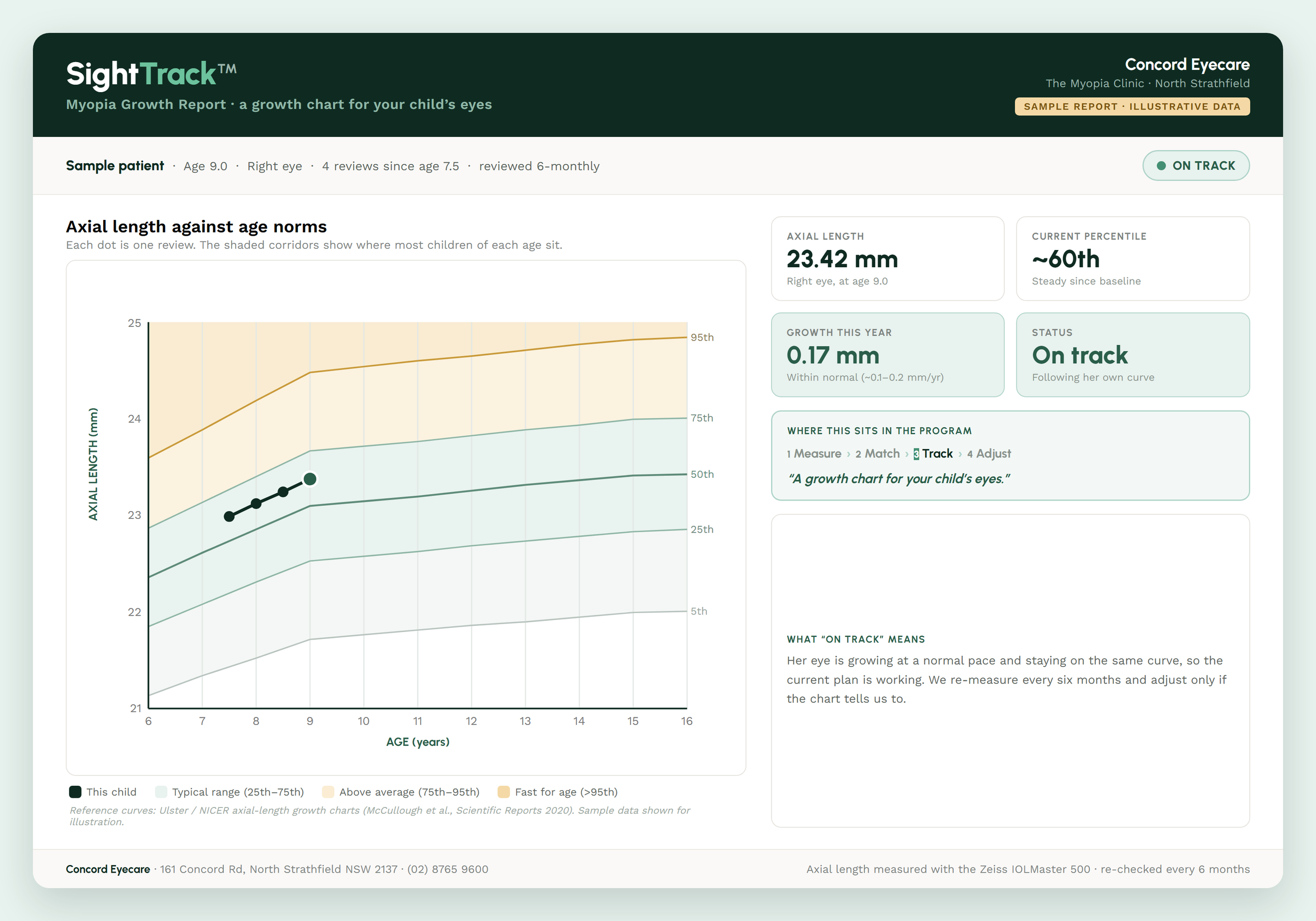
What is axial length — and why we treat it like a growth chart for your child’s eyes
Axial length is the front-to-back length of the eyeball, measured in millimetres. Short-sightedness (myopia) is really a story of an eye growing too long. By measuring axial length, we can track that growth directly — and plot it on a growth chart, just like we track a child's height, to see whether it's growing faster than it should.
What is axial length, and why does it matter for my child's eyes?
Axial length is the distance from the front of the eye (the cornea) to the back (the retina). A typical adult eye is roughly 23–24 mm long. In short-sightedness the eye is too long for its focusing power, so distance vision blurs. Tracking that length tells us how myopia is genuinely progressing — not just how strong today's glasses are.
How is axial length different from a glasses prescription?
A glasses prescription tells you how blurry vision is today; axial length tells you how much the eye has physically grown. A prescription can shift with tiredness, focusing effort and test conditions. Axial length is a stable, physical measurement — so it's a more precise, earlier signal of real myopia progression.
| Glasses prescription (refraction) | Axial length | |
|---|---|---|
| What it measures | How blurry vision is now (dioptres) | Physical length of the eye (mm) |
| Changes with | Tiredness, focusing, pupil size, test conditions | Only real structural growth |
| Best for | Prescribing lenses today | Tracking progression over time |
| Detects change | After vision has already shifted | Often earlier, before the script moves |
In short: the prescription tells us what lenses your child needs now, while axial length tells us whether the underlying myopia is speeding up or slowing down. Used together, they give a far clearer picture than either number alone.
A growth chart for your child's eyes
Just as a paediatrician plots a child's height against age-based percentiles, we plot your child's axial length against normal eye-growth curves for their age. At each visit we can see whether their eyes are tracking along a healthy percentile or climbing too quickly — it turns a single millimetre reading into something you can actually see and understand.
This is the heart of how we manage myopia at Concord Eyecare, and because normal growth differs by background, we compare against the right reference population for your child.
What's a normal amount of eye growth?
Eyes grow naturally through childhood, so some increase in axial length is completely normal — as a rough guide, in the order of 0.1–0.2 mm per year, and faster in younger children. What matters isn't a single reading but the pattern against age-appropriate norms. Growth that outpaces the expected curve is the signal we watch for.
Why does a longer eye matter for long-term eye health?
As the eye lengthens, the retina at the back is stretched thinner. Research links longer eyes with a higher lifetime chance of conditions such as retinal detachment, glaucoma and myopic maculopathy later in life (Tideman et al., 2016). That's why modern myopia care aims to slow eye growth in childhood — the goal is protecting long-term eye health, not just sharpening vision now.
Can anything slow how fast a child's eyes are growing?
Yes. Evidence-based myopia management — orthokeratology (overnight lenses), MiyoSmart spectacle lenses, MiSight daily contact lenses and, in some cases, atropine eye drops — is clinically shown to slow eye growth in many children. No option stops growth entirely and results vary, which is exactly why we measure axial length: the growth chart tells us whether the chosen approach is working, so we can adjust early.
How do you measure axial length?
We measure it with a Zeiss IOLMaster 500 — optical biometry that takes a quick, non-contact scan. Nothing touches the eye, no dilating drops are needed for the measurement, and it's repeatable to a fraction of a millimetre, so small changes show up reliably at each visit. It's painless and easy, even for young children.
Why we track axial length at every myopia visit
At Concord Eyecare in North Strathfield, axial-length tracking is the "Track" step of how we manage short-sightedness — measure the eye, plot it on its growth chart, and adjust the plan early rather than waiting for the prescription to jump. Across more than 800 Ortho-K fittings, that measure-and-adjust rhythm is how we get the best long-term result for each child.
Worried your child's short-sightedness is getting worse?
Book a myopia assessmentor call us on (02) 8765 9600
Axial length, answered
Is measuring axial length painful, or does it need drops?
No. It's a quick, non-contact scan with the IOLMaster — nothing touches the eye and no dilating drops are needed for the measurement. Most children find it easy.
My child's prescription didn't change — why measure axial length too?
Because the eye can keep growing before the prescription visibly shifts. Axial length often catches progression earlier, so we can act sooner rather than after vision has already changed.
Does adult axial length change?
For most adults it's stable. The main concern is childhood and the teenage years, when myopia typically progresses fastest.
Can axial length be reversed?
No — the aim is to slow further growth, not reverse it. That's why starting myopia management early, and tracking it, matters.
References: McCullough SJ, Saunders KJ et al. (NICER axial-length growth charts), Scientific Reports 2020;10:15189. Tideman JWL et al. Association of axial length with risk of visual impairment, JAMA Ophthalmol 2016.