
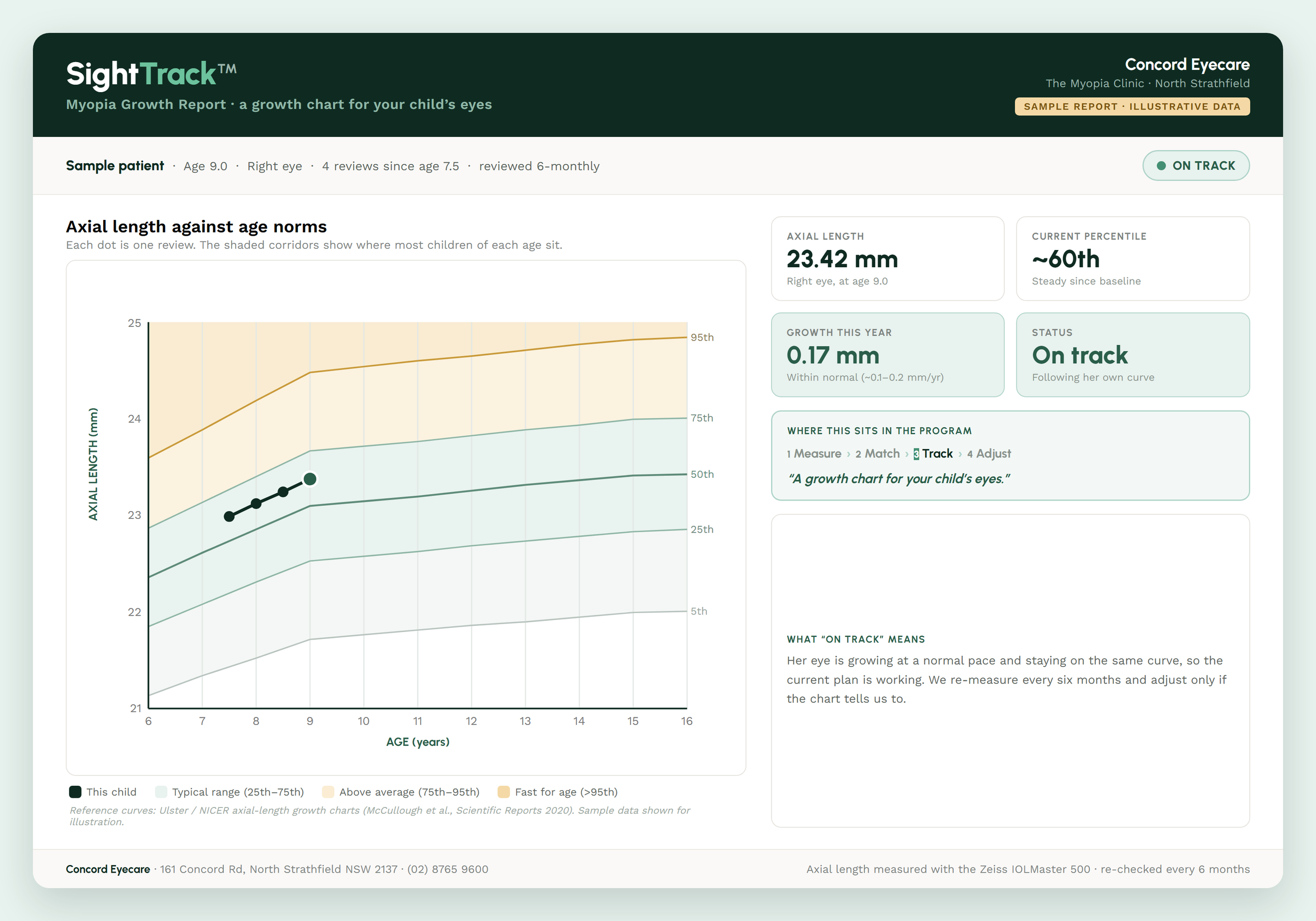
What is axial length — and why we treat it like a growth chart for your child’s eyes
Axial length is the front-to-back length of the eyeball, measured in millimetres. Short-sightedness (myopia) is really a story of an eye growing too long. By measuring axial length, we can track that growth directly — and plot it on a growth chart, just like we track a child's height, to see whether it's growing faster than it should.
What is axial length, and why does it matter for my child's eyes?
Axial length is the distance from the front of the eye (the cornea) to the back (the retina). A typical adult eye is roughly 23–24 mm long. In short-sightedness the eye is too long for its focusing power, so distance vision blurs. Tracking that length tells us how myopia is genuinely progressing — not just how strong today's glasses are.
How is axial length different from a glasses prescription?
A glasses prescription tells you how blurry vision is today; axial length tells you how much the eye has physically grown. A prescription can shift with tiredness, focusing effort and test conditions. Axial length is a stable, physical measurement — so it's a more precise, earlier signal of real myopia progression.
| Glasses prescription (refraction) | Axial length | |
|---|---|---|
| What it measures | How blurry vision is now (dioptres) | Physical length of the eye (mm) |
| Changes with | Tiredness, focusing, pupil size, test conditions | Only real structural growth |
| Best for | Prescribing lenses today | Tracking progression over time |
| Detects change | After vision has already shifted | Often earlier, before the script moves |
In short: the prescription tells us what lenses your child needs now, while axial length tells us whether the underlying myopia is speeding up or slowing down. Used together, they give a far clearer picture than either number alone.
A growth chart for your child's eyes
Just as a paediatrician plots a child's height against age-based percentiles, we plot your child's axial length against normal eye-growth curves for their age. At each visit we can see whether their eyes are tracking along a healthy percentile or climbing too quickly — it turns a single millimetre reading into something you can actually see and understand.
This is the heart of how we manage myopia at Concord Eyecare, and because normal growth differs by background, we compare against the right reference population for your child.
What's a normal amount of eye growth?
Eyes grow naturally through childhood, so some increase in axial length is completely normal — as a rough guide, in the order of 0.1–0.2 mm per year, and faster in younger children. What matters isn't a single reading but the pattern against age-appropriate norms. Growth that outpaces the expected curve is the signal we watch for.
Why does a longer eye matter for long-term eye health?
As the eye lengthens, the retina at the back is stretched thinner. Research links longer eyes with a higher lifetime chance of conditions such as retinal detachment, glaucoma and myopic maculopathy later in life (Tideman et al., 2016). That's why modern myopia care aims to slow eye growth in childhood — the goal is protecting long-term eye health, not just sharpening vision now.
Can anything slow how fast a child's eyes are growing?
Yes. Evidence-based myopia management — orthokeratology (overnight lenses), MiyoSmart spectacle lenses, MiSight daily contact lenses and, in some cases, atropine eye drops — is clinically shown to slow eye growth in many children. No option stops growth entirely and results vary, which is exactly why we measure axial length: the growth chart tells us whether the chosen approach is working, so we can adjust early.
How do you measure axial length?
We measure it with a Zeiss IOLMaster 500 — optical biometry that takes a quick, non-contact scan. Nothing touches the eye, no dilating drops are needed for the measurement, and it's repeatable to a fraction of a millimetre, so small changes show up reliably at each visit. It's painless and easy, even for young children.
Why we track axial length at every myopia visit
At Concord Eyecare in North Strathfield, axial-length tracking is the "Track" step of how we manage short-sightedness — measure the eye, plot it on its growth chart, and adjust the plan early rather than waiting for the prescription to jump. Across more than 800 Ortho-K fittings, that measure-and-adjust rhythm is how we get the best long-term result for each child.
Worried your child's short-sightedness is getting worse?
Book a myopia assessmentor call us on (02) 8765 9600
Axial length, answered
Is measuring axial length painful, or does it need drops?
No. It's a quick, non-contact scan with the IOLMaster — nothing touches the eye and no dilating drops are needed for the measurement. Most children find it easy.
My child's prescription didn't change — why measure axial length too?
Because the eye can keep growing before the prescription visibly shifts. Axial length often catches progression earlier, so we can act sooner rather than after vision has already changed.
Does adult axial length change?
For most adults it's stable. The main concern is childhood and the teenage years, when myopia typically progresses fastest.
Can axial length be reversed?
No — the aim is to slow further growth, not reverse it. That's why starting myopia management early, and tracking it, matters.
References: McCullough SJ, Saunders KJ et al. (NICER axial-length growth charts), Scientific Reports 2020;10:15189. Tideman JWL et al. Association of axial length with risk of visual impairment, JAMA Ophthalmol 2016.