
Scleral lenses · Concord Eyecare, North Strathfield
Scleral Lenses Sydney
A large rigid lens that vaults right over your cornea and holds a layer of fluid against it all day. Two very different groups of people end up here — and the honest answer is different for each.
$2,200
both eyes — lenses, fitting and two years of reviews
Measured, not guessed
we scan the space under the lens rather than judging it by eye
Made to your eye
custom made in Australia, not picked off a shelf
Reviewed by Dr Mark Joung, B.Optom (Hons) UNSW · Last updated August 2026
Scleral lenses for dry eye
Tried everything and still burning? It depends which kind of dry eye you have.
Where sclerals help
Aqueous-deficient and severe dry eye
Sjögren’s syndrome, graft-versus-host disease, Stevens-Johnson syndrome, and other conditions where tear production has genuinely failed — your eyes are not making enough tears, rather than losing them too fast.
The lens holds preservative-free saline against the cornea all day — it does the hydrating your own tears cannot. This is where the evidence is strongest: in people with severe disease, symptom scores roughly halved, from about 68 to about 35 in one prospective trial.
Where they’re usually not the answer
Evaporative dry eye and MGD
The common type — meibomian glands that are blocked or sluggish, so the tears you do make evaporate too fast.
Sclerals do not fix the glands, and there is little evidence they help this group. The tool that treats the cause is IPL plus lid therapy. We will steer you there first rather than sell you a lens that works around your problem.
How we do it at Concord Eyecare
So we don’t jump to scleralsWe start with diagnosis — meibography with our Meibovue device, which photographs the oil glands in your eyelids, and tear-film measurement with the Medmont E300 — and then work through treatments in order of how involved they are.
To be clear, this is our own order of preference, not an official guideline. No consensus report sets a fixed sequence, and there are practices that would go to a scleral lens sooner than we would. We work this way because treating the cause is usually simpler, cheaper and longer-lasting for you than working around it — and because we would rather not fit you a lens you turn out not to need.
For Sjögren’s the combination works well: IPL addresses any gland component while sclerals compensate for the aqueous deficiency IPL cannot fix. Co-managed with your rheumatologist.
The 2025 international dry eye consensus report (TFOS DEWS III) places scleral lenses under tear conservation — keeping the eye’s own moisture on the surface — alongside punctal plugs and moisture-retaining glasses.
Notably it does not rank those options in an order — which is why the sequence above is ours rather than anyone’s official recommendation. The same report says plainly that robust studies supporting scleral lenses for dry eye are lacking — most of what is known comes from small case series, and the symptom-score halving above is one of them. We would rather you knew that before you decide. If you have been offered a lot of confident promises about dry eye over the years, that is exactly why.
Scleral lenses for keratoconus and irregular corneas
When the shape is the problem, the lens becomes your new front surface.
Average vision in glasses, then in scleral lenses — from a keratoconus series of 157 eyes. In a separate study of 112 eyes with irregular corneas, vision improved by around five lines on the chart. Both figures are measured against spectacles, not against other contact lenses. Results vary between individuals.
This also covers pellucid marginal degeneration, corneas that have had a graft, and irregularity left behind by earlier surgery. Unlike ortho-K, which reshapes a regular cornea overnight and is removed during the day, a scleral vaults over an irregular one and is worn while you are awake. Different tools, different problems.
What a scleral lens does
Gives you back sharp vision
Often the best you have had in years, and it can do it on the day the lenses go on.
What it does not do
Stop the cone changing
In 157 eyes followed at least a year, about 15% lost some of their best lens-corrected vision as the keratoconus progressed underneath a well-fitting lens. Corneal cross-linking is the treatment aimed at progression, and we refer for it.
What are scleral lenses
Why it can work when nothing else has.
Every other lens depends on the surface of your eye being good enough to work with — which is exactly what your eye may not have. A scleral lens skips that surface entirely: it arches right over the cornea and rests on the white of the eye, which has far fewer nerve endings, and the space underneath is filled with preservative-free saline before the lens goes in.
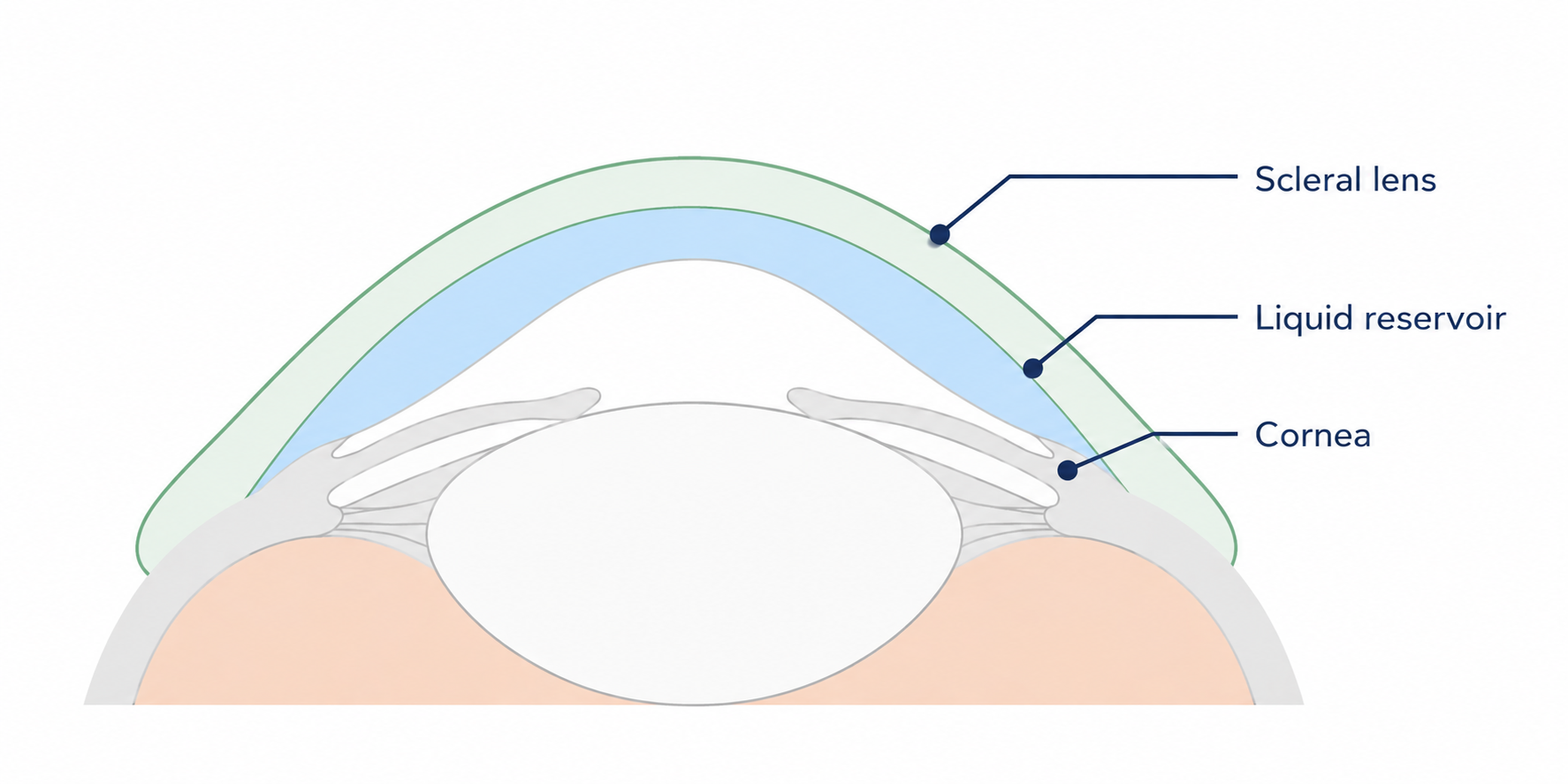
So what does that mean when you are choosing? The table is the short version — the right-hand column is the reason each row matters.
| Scleral lens | Soft lens | Corneal rigid lens | Why it matters to you | |
|---|---|---|---|---|
| Rests on | The white of the eye | The cornea | The cornea | Landing off the cornea is why a scleral can be worn on an eye that rejects other lenses |
| Fluid underneath | Yes — a saline reservoir | No | No | The reservoir is what treats a dry surface as well as correcting vision |
| Irregular cornea | Vaults over it | Drapes over it | Sits on it | Only vaulting fully neutralises the distortion |
| Comfort at insertion | Learning curve | Immediate | Adaptation needed | Sclerals take practice to handle, then are usually the most comfortable rigid option |
| Replacement | About 2 years | Daily to monthly | 1–2 years | A longer life offsets the higher upfront cost |
Ready to find out if sclerals are right for you?
No referral needed. Appointments Monday to Saturday.
Book a Scleral Lens Assessment Call (02) 8765 9600What to expect from scleral lenses
More comfortable than smaller rigid lenses. Not effortless.
Vision
Usually excellent. The saline reservoir gives a smooth optical surface regardless of the shape underneath, so the improvement can be dramatic on an irregular cornea. What sclerals do not do is stop keratoconus progressing — cross-linking is aimed at that, and the two work together.
Comfort
In a survey of over 400 people with keratoconus, comfort scored 3.3 out of 5 for scleral lenses against 2.2 for corneal rigid lenses.
More comfortable is not the same as perfect: two thirds of wearers in that survey still reported some discomfort. You will be aware of the lens. It should not hurt.
Insertion and removal
Takes practice, and this is the part people underestimate — most get confident within one to two weeks. We teach you on fitting day and keep going until you can manage alone, as often as you need, at no charge.
Midday fogging
Somewhere between a quarter and a half of wearers get clouding partway through the day, as debris builds up in the fluid layer.
The fix takes a few minutes: out, rinse, refill with fresh saline, back in. Manageable — and worth knowing before you start rather than after.
One more honest note. Against corneal rigid lenses, a randomised trial found sclerals significantly more comfortable but measured no advantage in vision, and preference split almost evenly. So if you already wear a smaller rigid lens happily, there is no vision reason to switch. If you are taking it out by mid-afternoon, that is the reason — and it is a good one.
How we fit scleral lenses
A program, not a single appointment.
Assessment and mapping
A full examination, then detailed mapping of your cornea and the white of your eye, so the lens is designed to your eye’s actual shape rather than adapted from a standard one. A trial lens from our diagnostic fitting set lets us check the fit and your prescription on the day.
Fitting day
Your custom-made lenses arrive from the lab. We put them on, confirm with the scan that they sit exactly as designed, and start teaching you insertion and removal.
Recheck
You come back later the same day, lenses still in. A scleral settles over the first hours of wear, so we measure the fit as it ends up rather than how it looked at insertion. Handling training carries on until you are confident — come back as often as you need, no charge.
Reviews — all included
Comfort, vision, fit and the health of your eye’s surface, plus any handling or fogging niggles. All included in the one fee.
Six-monthly reviews
Regular monitoring to keep the fit right and your eye healthy — more often if your condition is advanced or changing. Lenses typically last about two years before replacement.
A scleral has to arch over your cornea with a layer of fluid underneath — not touching it, and not sitting too far off it either. We measure that space with a scan rather than estimating it down the microscope. In a study of 66 contact lens practitioners, estimating it by eye overshot the scan by roughly the thickness of a sheet of paper — and experienced fitters were no more accurate than newer ones. The whole range that works is only about two sheets thick, so measuring rather than guessing is the difference between a lens that fits and one that needs changing.
How much do scleral lenses cost in Australia
One price to start. Less to keep going.
To start
$2,200
Both eyes — the lenses and the whole fitting program
The assessment and all scans
Both lenses, custom made for your eyes in Australia
Every fitting appointment, and two years of reviews
Handling training, for as long as you need it
A three-month starter solution supply
Six months to get the fit right — changes and breakage
Then, when lenses are due
$1,400
Per two-year cycle, once your first lenses need replacing
A fresh pair of lenses
The assessment that goes with them
All reviews across those two years
The first payment carries the fitting work — the scans, the design, and the appointments it takes to get a lens sitting right on your eye. That work is done once, which is why keeping the lenses going costs less than starting them.
For six months from collection, any change to the lens design or power needed to get the fit right is at no cost, and so is breakage. That is the settling period, when changes are most likely, and it is the window we guarantee.
Beyond six months, if your prescription changes or a lens needs replacing, we will quote it before ordering anything. Lenses last about two years in normal wear — when yours are due, that is the $1,400 cycle above.
Scleral lenses come out of your ordinary optical extras limit. There is no separate benefit for medically necessary contact lenses, so for most funds that is a few hundred dollars a year. We will give you an itemised receipt to claim against.
Solutions are similar to any rigid lens care routine. We will walk you through the full picture at your assessment, before you commit to anything.
Are scleral lenses right for you
We’ll tell you straight — including when the answer is not yet.
That is the common type, and sclerals do not fix the blocked glands causing it. IPL and lid therapy treat the cause — a cheaper, less involved path, and the one we would try first.
Against smaller corneal rigid lenses the measured advantage of a scleral is comfort, not vision. If yours is comfortable and you wear it all day, changing costs money and gains nothing.
A scleral is a bigger lens that needs filling with saline before it goes in. Most people manage within a week or two and we keep teaching until you do — but if handling genuinely will not work, better to find that out at the assessment than after the lenses are made.
None of these rules a scleral lens out. They are the things we examine properly before fitting, and where we may want an ophthalmologist’s view alongside ours.
Which conditions, and why
Frequently asked questions
Scleral lenses — what patients ask us.
How much do scleral lenses cost in Australia?
At Concord Eyecare the program is $2,200 for both eyes — assessment, scans, both lenses, every fitting appointment, a starter solution supply, six months to get the fit right at no cost, and two years of reviews. Lenses last about two years; a new two-year cycle is then $1,400 including the replacement lenses. They come out of your ordinary optical extras limit; there is no separate health-fund benefit for medically necessary lenses.
What are the downsides of scleral lenses?
Three, honestly. Insertion and removal take practice — most people are confident within one to two weeks, but it is a real learning curve. Between a quarter and a half of wearers get midday fogging that needs the lens rinsed and refilled. And they cost more upfront than soft lenses. They also do not treat everything: for evaporative dry eye, the common type, they are usually not the right answer.
Are scleral contacts covered by Medicare?
The lenses are not covered by Medicare. Private funds treat them as ordinary optical extras rather than a separate medically-necessary category, so what you claim comes out of your usual annual optical limit — for most funds, a few hundred dollars. We will give you an itemised receipt.
Can you get 20/20 vision with scleral lenses?
Many people do, and for an irregular cornea the improvement over glasses can be dramatic — in one keratoconus series average vision went from about 6/19 in glasses to about 6/7.5 in scleral lenses, measured against spectacles. What nobody can promise is a specific result for your eye: that depends on how irregular your cornea is and whether there is scarring, which is what the assessment is for.
How long do scleral lenses last?
About two years in normal wear. We check the condition of the lens at your reviews and tell you when yours is getting close, rather than leaving you to notice. A replacement two-year cycle is $1,400 for the pair.
Can you sleep in scleral lenses?
No — scleral lenses are for daytime wear and come out before you sleep. The fluid layer cannot refresh overnight, and closed-eye wear raises the risk to the cornea. If overnight wear is what you want, that is ortho-K — a different treatment for a different problem, and not for irregular corneas.
Can scleral lenses help with dry eye?
For severe aqueous-deficient dry eye — where your eyes cannot make enough tears, as in Sjögren’s syndrome — yes. The lens holds preservative-free saline against the cornea all day, and symptom scores roughly halved in one prospective trial. For the far more common evaporative type we treat the cause first with IPL. The 2025 consensus report also states plainly that robust studies for sclerals in dry eye are lacking.
Further reading
Where to go next.
References
- Craig JP, et al. TFOS DEWS III Management and Therapy Report. The Ocular Surface. 2025.
- Fuller DG, Wang Y. Safety and efficacy of scleral lenses for keratoconus. Optometry and Vision Science. 2020;97(9):741–748.
- Levit A, Benwell M, Evans BJW. Randomised controlled trial of corneal vs scleral rigid gas permeable contact lenses for keratoconus. Contact Lens and Anterior Eye. 2020;43(6):543–552.
- Shorter E, Schornack M, Harthan J, et al. Keratoconus patient satisfaction and care burden with corneal gas permeable and scleral lenses. Optometry and Vision Science. 2020;97(9):790–796.
- Koppen C, Kreps EO, Anthonissen L, et al. Scleral lenses reduce the need for corneal transplants in severe keratoconus. American Journal of Ophthalmology. 2018;185:43–47.
- Fadel D, Herzberg C. Potential contraindications to scleral lens wear. Contact Lens and Anterior Eye. 2018;41(6):S17.
- Harthan JS, et al. Therapeutic uses of scleral contact lenses for ocular surface disease. Clinical Optometry. 2018;10:65–74.
- Schornack MM. Scleral lenses: a literature review. Eye & Contact Lens. 2015;41(1):3–11.
- Bavinger JC, et al. Scleral lens use in dry eye syndrome. Current Opinion in Ophthalmology. 2015;26(4):319–324.
Last updated August 2026
Book a scleral lens assessment
Find out whether a scleral lens is your answer — or whether something simpler is.
One assessment tells us which kind of problem you actually have, and we will give you a straight answer either way. If the honest answer is that something else should be tried first, that is what we will say.
Find out if sclerals can help my eyes Or call (02) 8765 9600Concord Eyecare, North Strathfield — seeing patients from across Sydney. No referral needed. Appointments Monday to Saturday.
Serving Sydney families: Concord · Drummoyne · Abbotsford · Burwood · Five Dock · Strathfield · Homebush · Rhodes
Let's find the right lens for you
No referral needed. Appointments Monday to Saturday.
Book a Scleral Lens Assessment Call (02) 8765 9600